
Flat products



High-grip stainless steel profiles, PPinox’s experience in the grating industry
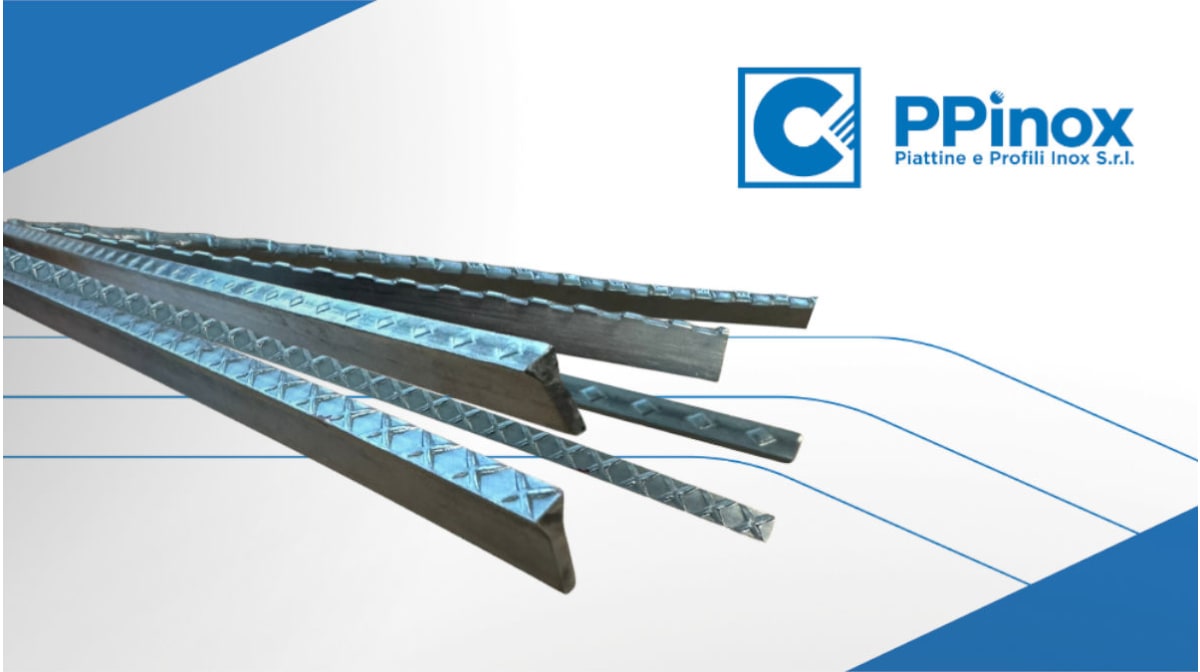
How can pedestrian walkways be made safer without changing established grating manufacturing processes? This practical challenge led PPinox to develop a range of custom-made high-grip stainless steel profiles.
Profile development
The initial request came from companies specializing in grating for pedestrian walkways. They needed components that could improve surface grip and increase the coefficient of friction while remaining fully compatible with existing manufacturing and assembly processes.
In response, PPinox developed several solutions in-house, ranging from flat bars with knurled edges to profiles with triangular, trapezoidal, and custom cross-sections. The high-grip surface can also be tailored to the specific application, using serrations, X-shaped impressions, or patterns developed to customer specifications.
The challenge of cold rolling
Creating the high-grip pattern through cold rolling is the most technically demanding stage of the process. Forming the pattern requires high forces to be concentrated on relatively small tooling, making the design of both the tooling and the overall production process critical.
Because the pattern can only be formed during the final processing step, PPinox develops a dedicated production cycle for each profile to ensure dimensional accuracy, a consistent surface finish, and long tool life.
PPinox’s expertise in this process also makes it possible to apply the same technology to a wide range of geometries and surface patterns. In some projects, initial trials have led to the development of proprietary surface finishes specifically requested by the customer, with the pattern kept confidential.
Lower weight, larger high-grip surface
In addition to improving safety, profile geometry can also enhance component efficiency. Compared with a conventional knurled flat bar, specially designed profiles can provide a larger high-grip surface while keeping weight per unit length low. This is particularly important when optimizing the balance between usable surface area, weight per unit length, and overall cost.
The most commonly used materials are AISI 304 and AISI 316L austenitic stainless steels, selected for their corrosion resistance, formability, weldability, and hygienic properties. Profile geometries and dimensions are defined according to the specific application and customer requirements.
The result is a custom high-grip profile that can be seamlessly integrated into grating without requiring major changes to existing manufacturing processes. Its dimensional, mechanical, and processing characteristics remain consistent with those of conventional profiles, combining walkway safety, design flexibility, and manufacturing efficiency.
