Wire rod


European titanium market: Hermith sees strong aerospace demand amid supply chain shifts
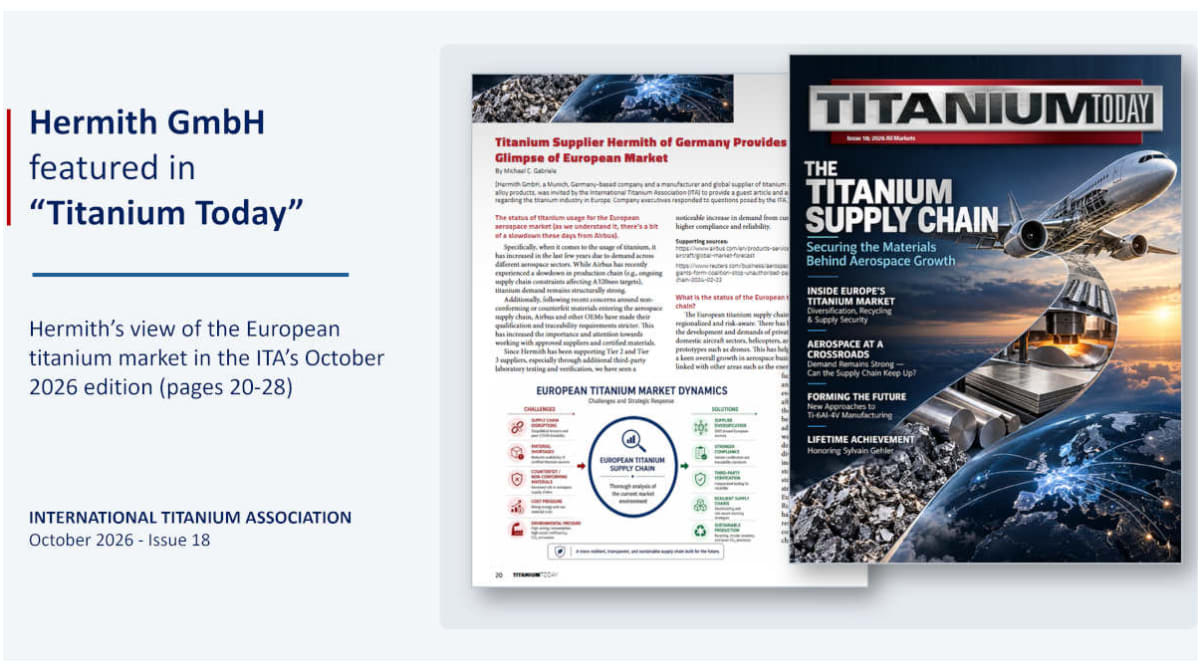
The European titanium market is undergoing significant changes, driven by stricter quality requirements, evolving sourcing strategies, and growing sustainability expectations. In a recent feature published in Titanium Today, the industry magazine of the International Titanium Association (ITA), Germany-based titanium supplier Hermith GmbH shared its perspective on the developments shaping the sector and the opportunities ahead for manufacturers, processors, and distributors.
Aerospace demand and material traceability remain key priorities
Despite recent production slowdowns among major aerospace OEMs, partly caused by supply chain constraints, demand for titanium in the aerospace industry remains structurally strong, according to Hermith.
At the same time, material certification and traceability requirements are becoming increasingly stringent. Recent concerns surrounding non-conforming and counterfeit materials have prompted OEMs to reinforce their supplier qualification and verification procedures.
Hermith supports Tier 2 and Tier 3 suppliers through additional third-party laboratory testing and verification, responding to growing customer demand for material compliance and reliability.
European titanium supply chains shift toward diversification and resilience
The COVID-19 pandemic and subsequent geopolitical and economic developments have accelerated the restructuring of Europe's titanium supply chain.
Manufacturers and suppliers are increasingly focusing on supplier diversification, strategic inventory management, and European and non-Russian sourcing alternatives to reduce supply risks.
According to Hermith, these strategies have helped strengthen supply chain resilience while also increasing cost sensitivity, particularly as energy and raw material prices remain major challenges for the industry.
High-performance titanium alloys and emerging applications
Aerospace currently accounts for approximately 75% of Hermith's production, followed by the medical sector at 20%, while automotive, industrial, and other applications represent the remaining 5%.
Beyond these established markets, the company identifies promising opportunities in offshore wind energy, hydrogen technologies, drones, light aviation, and additive manufacturing. Demand for medical implants, supported by an ageing population, is also expected to contribute to market expansion.
On the materials side, Hermith observes increasing interest in high-performance titanium alloys, including Ti-6242, Ti-6246, Ti-662, and beta alloys such as Ti-10V-2Fe-3Al. These alloys are increasingly sought after for demanding applications requiring combinations of low weight, high mechanical strength, and, in certain cases, elevated-temperature performance.
Technological developments are also influencing the market outlook. Titanium recycling, circular supply chains, lower-CO₂ production methods, and the growing adoption of metal additive manufacturing in aerospace and medical applications are among the trends expected to shape the industry's future.
Looking ahead, Hermith expects the European titanium market to be driven by rising aerospace production, greater supply chain localization, and increasingly demanding sustainability requirements. The ability to combine certified material quality, secure sourcing, and technological innovation will remain central to the industry's development.
Hermith's market insights were featured in “Titanium Supplier Hermith of Germany Provides a Glimpse of European Market,” written by Michael C. Gabriele and published on pages 20–28 of the October 2026 edition of Titanium Today.
