Wire tools


QP Mechanics: carbide as a strategic choice for production
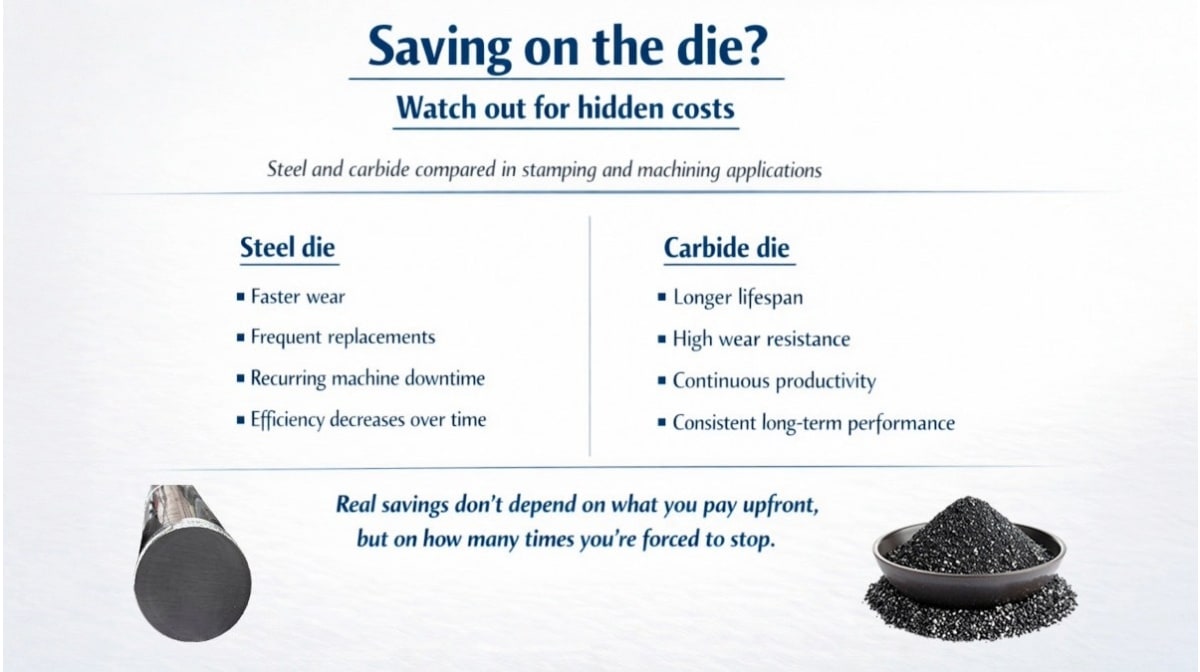
In metal forming, process stability and tool life are directly influenced by material selection. QP Mechanics addresses these challenges through the design and manufacturing of steel and carbide tooling for stamping, blanking, extrusion, and wire forming applications.
With a technical approach grounded in the analysis of real working conditions, QP Mechanics supports its customers in identifying the most suitable solution in terms of wear resistance, dimensional precision, and long-term return on investment.
Carbide: real properties and advantages
Carbide is a composite material made of extremely hard particles — primarily tungsten carbide — bonded together by a metallic binder, typically cobalt. This combination produces a material with significantly higher hardness and wear resistance than tool steels or high-speed steels, while retaining a minimal level of toughness.
One of carbide’s defining characteristics is its ability to maintain performance at high temperatures without losing hardness or undergoing plastic deformation. For this reason, it is widely used in applications exposed to severe wear, abrasion, and thermal stress — for example, in the production of high-performance cutting tools, inserts, and components subject to continuous mechanical loads.
The properties of carbide largely depend on its microstructure: by adjusting the binder content and carbide grain size, it is possible to obtain materials that are either harder and more wear-resistant or slightly tougher and less brittle. This flexibility allows the material to be tailored to a wide range of production environments.
QP Mechanics’ approach
For QP Mechanics, carbide is not a one-size-fits-all solution but a technical decision driven by data. Each project begins with a thorough assessment of the material to be processed, the load conditions, and the specific tool requirements.
Thanks to this approach, QP Mechanics delivers custom tooling solutions that:
• optimize the production cycle;
• extend tool lifespan;
• reduce maintenance frequency and replacement costs.
When investing in carbide truly pays off
The high cost of carbide is directly related to both its performance and its complex manufacturing process. Powder metallurgy requires highly specialized equipment and extremely precise process control in all its stages. On top of that, raw materials such as tungsten and cobalt are scarce and subject to significant market fluctuations.
Compared to steel, carbide is also much more challenging to machine: diamond tools are required for finishing or sharpening, and machining times are considerably longer — all factors that further impact the final cost.
But the balance shifts when considering the tool’s entire life cycle. In high-speed machining, abrasive material processing, or cold-forming applications, the superior durability and dimensional stability of carbide lead to a significant reduction in overall operating costs.
QP Mechanics supports its customers in identifying when carbide truly delivers measurable benefits by analyzing the balance between performance, lifespan, and long-term return on investment. Contact the QP Mechanics team to learn how its expertise can help you enhance your production processes.
